Monday, June 18, 2012

The Transit of Venus - 06.06.2012

One of this year's most important astronomical event has come and gone. It's been almost two weeks since the event, but only now I've managed to work on the photos and find some quiet time to update my blog.

First and foremost, it's been a wonderful adventure, one that I will always remember fondly.

This adventure starts Tuesday evening, on June 5th, with pretty glum weather forecasts. It seems like the best chance for a clear sky lies about 150-200 km west from Bucharest. There's also a chance the skies will clear    at about 150-200 km east. So... what to do and which direction to take. After all, the next transit is in 2117 so... no pressure. My team decides to go west, while the other members of the Bucharest Astroclub decide to go east. I feel like a tornado chaser, only we're chasing patches of clear skies :)

I pack my borrowed equipment (since I don't have a scope of my own yet), my cameras and my tripod and off we go. We leave the city at about 11 pm, just in time to make it to the selected site by sunrise. No incidents on the way, we pick a nice wheat field almost in the middle of nowhere and we set our equipment with time to spare...

By 5.30 am the sky looks clear, but awful winds threaten the sunrise... As it is, the sunrise comes and of course, in accord to Murphy's laws, the event happens behind a thick curtain of clouds... For the next minutes, we're all on edge looking at the sky and hoping that the winds will move the clouds fast enough so that we might actually see something.

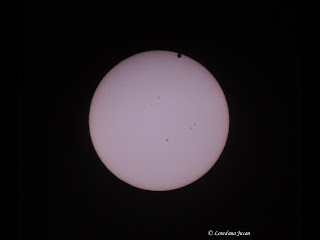
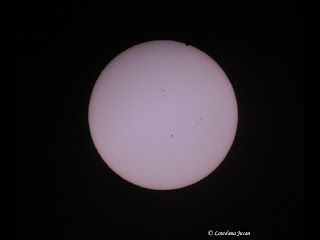
As if our prayers were listened to, at about 6.25 am the Sun makes a quick appearance (for a few minutes) and then hides behind the clouds again. I am able to take a few photos, but my settings are off, so they're underexposed... (as you can see). In my defense, it's the first time I've photographed the sun with a filter on and I was expecting an ISO of 200 or 400 to be enough...

06:30:54 am; Corabia, Romania

06:38:50 am, Corabia, Romania


The next hour is horrible for me. With only these images taken until now, I'm almost in a state of panic. All I could think of was that I really needed to get at least one good photo of the transit.

Apparently, someone loves me up there, because in the last half hour of the transit, the sky clears and the sun   is waiting for the photo session.

Here are a few of my photos. They're not processed too much... They're also a bit out of focus because the winds were really strong and my mount was not one of the sturdiest...

07:424:42 am

07:29:20 am

07:32:32 am

07:35:44 am

07:36:56 am

07:37:54 am - the Third Contact

07:38:46 am - the Third Contact

07:41:46 am

07:46:50 am

07:49:34 am

07:52:04 am

07:53:46 am - almost gone now and the Forth Contact is almost here

07:54:58 am - Venus is gone


All in all, it's been an incredible adventure and I'm looking forward to the next "hunt".

Sunday, January 1, 2012

First photos of 2012

Happy New Year everyone!

2012 starts with the first night with clear skies in weeks. So I could not pass up the opportunity to take some photos from my balcony: one with the Moon and Jupiter and one with Venus above the city.
The pictures may not be my absolute best, since I feel pretty rusty. It's been a long time since I found the time to indulge in my new hobby. One of my New Year's Resolutions is to practice more.

In the meantime, here is the photo of the Moon and Jupiter (Jupiter is the small dot on the far left of the Moon):

And here is Venus above the city, as seen from my balcony:

Friday, September 2, 2011

First star party

Last Saturday night I went on my first star party. It was a small one, with only 15-20 people present. But I had a lot of fun, despite the cold temperatures in the wee hours of the morning.
I learnt a few important things on this occasion:
1. if people say to dress warmly, then you should listen to them. There is definitely a big difference between night temperature in the city and in the fields, even in summer. 2-3 warm jackets are a good idea, an extra pair of trousers, some gloves even...
2. hot tea / coffee is not only welcomed... it's very welcomed. A sip of a hot beverage can make a whole lot of difference. And if it happens to energize you, all the better. The purpose is to stay up as long as possible and take as many photos as you can.
3. buy a flashlight. one of those that you can wear on your head and has two settings: white light and red light. Red light is extremely useful and does not affect your night vision.
4. bring extra batteries - I didn't actually need one this time and I don't even have one at the moment. But it's a thing to remember and invest in. Also applicable to extra memory cards.
5. food is needed - one item on the list I got right :)

I took a lot of pictures that night and I saw a lot of shooting stars. I'm gonna have to find some time in the next few days for post-processing these photos. I can't wait to see what I'll be able to produce.

Wednesday, August 24, 2011

The Big Dipper revisited

With a little help from a friend from the "Canon DSLR Digital Astro" yahoo group, I managed to tweak my image a little bit. I think it looks better :)

The method I used can be found here: http://www3.ns.sympatico.ca/b.macdonald/gallery/Stars&DSOs.htm. It was a bit tricky at first, but I nailed it in the end (at least at for my current level of absolute beginner).

Thank you Chuck for your help, and thank you Blair for writing the tutorial :)


I've also worked on another photo - The Scorpio. The entire constellation is not visible, only the head and the heart - Antares. This image was taken from my balcony so there's a lot of light pollution. Pretty much the same settings as before.
I've lost a little of the red of Antares in post-processing, but I'll correct it as soon as I know how.

Here it is:

If I thought taking astro-images was a bit hard, well... post-processing seems equally hard. But I'm not giving up :D

Sunday, August 21, 2011

The Big Dipper

One of my first tries in taking constellation pictures : The Big Dipper. Right now it's unprocessed because I haven't found a way to process it and be satisfied with the result. Actually, I like the raw file better than I do the processed image.
I'm still reading about how to prcess images, so hopefully I'll come back to this shot soon and post a processed version.

This picture was taken in the center of town, in a park, with a Canon 450 Xsi camera and a tripod.
Settings: ISO 400, 10 sec exposure and f/4.5 with an 18-55 mm lens.

You can see Alcor and Mizar clearly :) I don't have great eyes, so this is the first time I see the two :)


Tuesday, June 28, 2011

This is the first image I actually processed with a special stacking software - DeepSkyStacker. It's a great and easy to use program, but I still have to discover all it's functionalities.
This image is the result of stacking several pictures I took with my Nikon D90 camera and a telephoto lens. Because I didn't know at the time I would need dark and flat frames, I didn't take any. So this is the result of stacking only light frames (the images).
Now I have to discover how to keep the color in the final picture ;)

Wednesday, June 8, 2011

Saturn and Porrima

My latest photo - unedited.
I know it's not much, but for someone who is just starting, it's a lot :)
Saturn is on the left and Porrima (the second brightest star in Virgo) is on the right.